

Home Safe Buying Guide: What Pretoria Homeowners Should Know
A safe is one of those purchases people put off until after something goes wrong — a break-in, a fire, or simply realising there's nowhere secure to keep important documents, jewellery, or firearms. If you're weighing up your options, here's a practical, no-nonsense guide to buying and installing a home safe in Pretoria or Centurion.
In this guide:
- Why every home needs some form of safe
- Understanding burglary ratings
- Understanding fire ratings
- Choosing a locking mechanism
- Where and how to install your safe
- Special considerations for firearm safes
- Common safe-buying mistakes to avoid
- Looking after your safe over time
- Frequently asked questions
Why Every Home Needs Some Form of Safe
Not everything valuable in your home is something you'd notice missing immediately — passports, title deeds, spare cash, jewellery passed down through the family, or a firearm that legally needs secure storage. A safe isn't just about deterring opportunistic theft; it's also protection against fire, water damage, and simple misplacement. Combined with good locks on your doors and windows through a proper home security setup, a safe is one of the most cost-effective upgrades available.
It's also worth thinking about a safe as protection against your own household, not just outside intruders — domestic workers, visiting contractors, and even well-meaning family members are all people who might otherwise have casual access to a drawer or cupboard where valuables are kept in the open.
Understanding Burglary Ratings
Safes are typically rated according to how much resistance they offer against forced entry — prying, drilling, and sustained attack. When comparing safes, look for:
- Wall thickness and construction — thicker steel and reinforced door bolts resist prying and drilling far longer than thin, budget models.
- Number and placement of locking bolts — safes with bolts on multiple sides of the door resist being pried open far more effectively than a single-bolt design.
- Certified rating — where available, an independently tested burglary rating gives you an objective comparison rather than relying on marketing claims alone.
As a rule of thumb, the heavier and more solidly built the safe feels relative to its size, the more resistant it typically is.
Understanding Fire Ratings
Fire-rated safes are tested to keep their internal temperature below a threshold that would damage paper documents (typically around 175°C) for a specified period, often 30 minutes to an hour. This matters more than most homeowners expect — house fires regularly exceed 500°C, and ordinary steel cabinets offer very little real fire protection without proper insulation.
If you're storing documents, photographs, or anything paper-based alongside valuables, a fire rating is just as important as a burglary rating, and the two aren't the same thing — a safe can be excellent against theft while offering almost no fire protection, and vice versa.
Choosing a Locking Mechanism
Modern home safes generally use one of the following:
- Key locks — simple and reliable, but you need to keep the key secure and accessible in an emergency.
- Mechanical combination locks — no batteries to fail, but slower to open and require remembering (or securely storing) a combination.
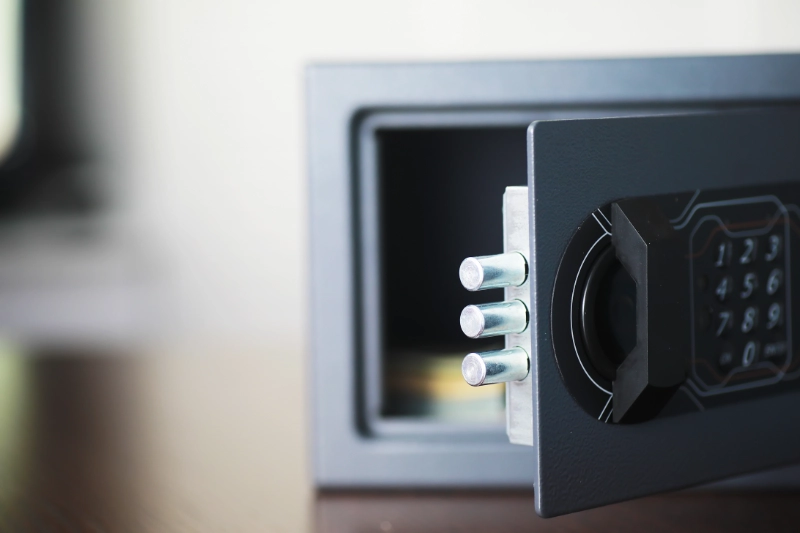
- Digital keypad locks — fast access and easy to reprogram, though they do rely on a battery, which should be checked periodically.
- Biometric locks — fingerprint access for fast, convenient opening, usually paired with a backup key or code for reliability.
There's no single "best" option — it depends on how often you'll be accessing the safe and who else needs access. A safe locksmith can talk you through the trade-offs based on your specific situation.
Where and How to Install Your Safe
Buying the right safe is only half the equation — an excellent safe installed poorly offers surprisingly little real protection. A safe that isn't properly secured to the structure of your home is far easier to simply remove entirely. Consider:
- Bolting the safe down — most quality safes have pre-drilled bolt holes for exactly this reason; use them.
- Choosing a location that isn't obvious — a safe visible from a window or immediately inside the front door is a target; a less predictable spot buys you time and discretion.
- Considering weight — for upper-floor installations, confirm the floor can support the safe's weight, particularly for larger models.
- Professional installation — a professionally fitted safe is significantly harder to remove than one simply placed in a cupboard.
- Accessibility in an emergency — balance discretion with being able to reach the safe quickly if you genuinely need to, particularly for firearm safes where fast access can matter.
Special Considerations for Firearm Safes
If you're storing a firearm, South African law requires it to be kept in a securely locked safe, strongroom, or similar device that meets specific requirements, separate from the ammunition where practical. Beyond the legal minimum, consider a safe rated specifically for firearms, with proper ventilation and racking, rather than repurposing a general-use safe. If you're unsure whether your current storage meets requirements, it's worth having it assessed rather than assuming it's adequate.
Firearm safes also tend to prioritise quick, reliable access over sheer size, since the practical use case is different from a document or jewellery safe — a biometric or keypad lock is often preferred here specifically because it removes the step of hunting for a physical key under pressure.
Common Safe-Buying Mistakes to Avoid
A few recurring mistakes are worth knowing before you buy:
- Buying based on price alone — a very cheap safe often means thin steel and a low-quality locking bolt, which defeats the purpose of buying one in the first place.
- Not bolting it down — an unsecured safe, however heavy, can simply be carried out by two people with a trolley. Bolting is not optional if security is the goal.
- Choosing size based only on today's needs — most people accumulate more over time than they expect, and safes are far easier to buy the right size once than to replace later.
- Assuming "fireproof" and "burglar-proof" are the same rating — as covered above, they test entirely different things, and a safe can excel at one while offering little protection against the other.
- Skipping professional installation to save money — a poorly installed safe undermines even the best hardware, and the installation cost is usually small relative to the value being protected.
Looking After Your Safe Over Time
A safe is low-maintenance, but not zero-maintenance:
- Replace digital lock batteries proactively, well before they're fully depleted, rather than discovering a dead battery when you actually need access.
- Keep hinges and bolts lightly lubricated if the safe sees frequent daily use, to prevent wear over time.
- Periodically confirm your combination or code still works, rather than assuming it does until the day you need it urgently.
- If you move house, have the safe professionally relocated and re-secured rather than simply carrying it to the new property and leaving it unbolted.
A safe locksmith can handle all of this as part of a routine service call, the same way you'd service any other piece of home security hardware.
Frequently Asked Questions
What size safe do I actually need?
Buy larger than your current needs. Almost everyone who buys a safe ends up wishing they'd bought the next size up within a year or two.
Can an old or damaged safe be repaired instead of replaced?
Often, yes — a jammed lock, worn keypad, or misaligned bolt can frequently be repaired by a safe locksmith without replacing the entire unit.
What happens if I forget my combination or the battery dies?
A trained locksmith can open most safes without damaging them, using proper manipulation or bypass techniques, and then help you reset access.
Do I need a professional to install my safe?
It's strongly recommended, particularly for bolting it down correctly and choosing an installation point that balances accessibility with discretion.
Should a safe be visible or completely hidden?
There's a reasonable argument for a semi-visible safe acting as a deterrent on its own, but most homeowners get better overall security from a discreet, properly bolted-down safe in a less predictable location.
Need Help Choosing or Installing a Safe?
Our safe locksmiths advise on the right safe for your home and install it securely.


 Mobile unit, Pretoria